Thursday, 20 September 2012
Student Loan Debt: Crisis or Overblown Hype?
Bubbles date back centuries, with the first on record occurring in 1634 in Holland, where the tulip market collapsed, leading to major losses from hundreds of speculators. Over the course of history, bubbles have popped and swallowed major economies, just as the real estate collapse of the mid-2000s did to the U.S. economy.
Of the 241 million people in the United States who have a credit report with Equifax, approximately 15.4% -- or 37 million -- hold outstanding student loan debt.
By Adrian Nazari

Tuesday, 18 September 2012
Prepare For An Unprecedented Wave Of College Bankruptcies
By Larry Doyle
That attention is deserved when a level of debt surpasses $1 TRILLION....
It's far too easy to borrow money for college. Did you know that there is more outstanding debt for student loans than there is for Auto Loans or Credit Card loans ? Thats right. The 37mm holders of student loans have more debt than the 175mm or so credit card owners in this country and more than the all of the debt on cars in this country. While the average student loan debt is about 23k. The median is close to $12,500. And growing. Past 1 TRILLION DOLLARS....
(Click on the links within the article in order to read more).
By Larry Doyle
Number of the Week: Student Loan Bubble
368%: The jump since 2007 in the measure of consumer credit held by the government comprised primarily of student loans.

Issuance of student loans has soared in recent years, hitting $867 billion at the end of 2011, according to an analysis from theFederal Reserve Bank of New York, more than credit cards or auto loans....
368%: The jump since 2007 in the measure of consumer credit held by the government comprised primarily of student loans.
By Phil Izzo
Wall Street-Inflated Student Debt Bubble Hits $1 Trillion; Debtors Rally for Relief
The collective weight of American student debt is now over $1 trillion, and that weight is a drag not just on those paying the debt, but on our entire economy. It's hard to calculate exactly, because the lenders are notoriously unwilling to hand over their data, and with students defaulting at ever-higher rates, interest rates and fees are always changing, adding constantly to the weight of the burden college graduates (and those who didn't graduate but still have to pay off the loans they took out in more hopeful times) carry.
How did we get here, with more student debt than credit card debt, with student loans rising twice as fast as mortgage debt at the height of the housing bubble? Recent graduates face terrifying unemployment number.
Konczal pointed out that the government makes a profit somewhere around 13 percent for each dollar of loans, and because the loans are not dischargeable in bankruptcy and Social Security payments can even be garnished to make them up, default may even be more profitable for lenders than borrowers making payments on time.
....student loans are repackaged, bundled and sold at auction. “The people who buy it are mainly the biggest banks in the world, hedge funds, etc.”....
By Sarah Jaffe
Tuesday, 14 August 2012
Private student loan debt reaches $150 billion
Americans have racked up $150 billion in private student loan debt, with many graduates owing more than they can afford, according to a new report from the Consumer Financial Protection Bureau.
Private student loans were aggressively marketed to students before the financial crisis and typically came with fewer protections and higher interest rates than federal loans, the report found.
Defaulted private loans currently total more than $8.1 billion, representing 850,000 individual loans.....
Private student loans used to be dischargeable in bankruptcy like any other consumer debt, but under a 2005 change to the bankruptcy code, private student loans can no longer be discharged unless borrowers can prove undue hardship -- the same rule that applies for discharging federal student loans.
And while federal interest rates are fixed, private loans typically carry varying -- and often higher -- interest rates based on credit worthiness...
Private student loans were aggressively marketed to students before the financial crisis and typically came with fewer protections and higher interest rates than federal loans, the report found.
Defaulted private loans currently total more than $8.1 billion, representing 850,000 individual loans.....
Private student loans used to be dischargeable in bankruptcy like any other consumer debt, but under a 2005 change to the bankruptcy code, private student loans can no longer be discharged unless borrowers can prove undue hardship -- the same rule that applies for discharging federal student loans.
And while federal interest rates are fixed, private loans typically carry varying -- and often higher -- interest rates based on credit worthiness...
............. By Blake Ellis

It seems the plight of middle-aged Americans clinging to middle class status deteriorated rapidly in just the few days that we’ve been away, this Wall Street Journal story from Tuesday catching my eye as I quickly leafed through the accumulated newspapers upon our return, primarily as a result of the graphic below. It wasn’t hard to predict this six or eight years ago: “Many parents—no longer able to tap home equity to pay for their children’s education—are taking out new student loans to do so”.
......By Tim
Sunday, 12 August 2012
Wall Street-Inflated Student Debt Bubble Hits $1 Trillion; Debtors Rally for Relief
The collective weight of American student debt is a drag not just on those paying the debt, but on our entire economy.

It's hard to calculate exactly, because the lenders are notoriously unwilling to hand over their data, and with students defaulting at ever-higher rates, interest rates and fees are always changing, adding constantly to the weight of the burden college graduates (and those who didn't graduate but still have to pay off the loans they took out in more hopeful times) carry.
How did we get here, with more student debt than credit card debt, with student loans rising twice as fast as mortgage debt at the height of the housing bubble? Recent graduates face terrifying unemployment numbers—ThinkProgress reported that over half of all college grads under the age of 25 are either jobless or underemployed and median wages for grads with bachelor's degrees are down from 2000—and delinquencies on debt is steadily climbing.
Those are complicated issues, because student lending is a complicated industry, one that highlights the degree to which the government is entwined with Wall Street, and state and federal policy play off one another to push students to ever greater levels of borrowing.
The Politics of Debt
Konczal pointed out that the government makes a profit somewhere around 13 percent for each dollar of loans, and because the loans are not dischargeable in bankruptcy and Social Security payments can even be garnished to make them up, default may even be more profitable for lenders than borrowers making payments on time. There's almost no risk of losses, which are the reason for high interest in the first place.
Students and recent graduates with heavy debt loads are at the base of the Occupy movement, and Paul Mason of the BBC has pointed out that the “graduates with no future ” were at the base of Egypt's revolution and the global fight against austerity.
Robert Oxford, a graduate student at NYU researching the financialization of student debt and an organizer with the Occupy Student Debt campaign, pointed out that even government-granted loans mean profits for the banks and the lenders that get paid to service the loans. “Profiteering on student indenture is common financial practice within the realm of Student Loan Asset Backed Securities,” he told AlterNet. “The 'servicers,' third parties the government contracts to bundle its student loans, are essentially middlemen which bring big finance to collateralize millions of American student loans.”
................ By Sarah Jaffe
Thursday, 26 July 2012
Is college worth the money and debt? The cost of college has increased by 11x since 1980 while inflation overall has increased by 3x. Diluting education with for-profits. and saddling millions with debt.The soaring cost of college
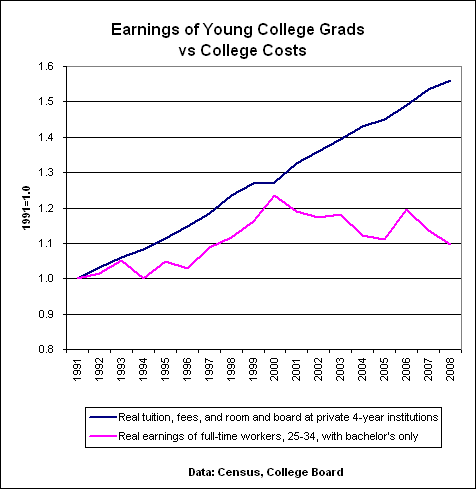
In hindsight everyone seems to now agree that the housing bubble was rather obvious to spot since it far outstripped every measure of inflation and even rose while incomes fell. You would think this lesson would be learned but the cost of a college education is much deeper into bubble territory even beyond the metrics of the housing market at its peak:

While housing at the peak rose by a factor of 4 (400 on the chart) college tuition has soared by a factor of 10 (it hasn’t stopped going up so it is now likely up in the 11x or 12x range). It is a downright startling figure especially when the incomes of recent college graduates has gone in the complete opposite direction:
Friday, 6 July 2012
The Ones We've Lost: The Student Loan Debt Suicides
Suicide is the dark side of the student lending crisis and, despite all the media attention to the issue of student loans, it has been severely under-reported.
Yoder had been a graduate student in organic chemistry at Illinois State University but after incurring $100,000 in student loan debt, he struggled to find a job in his field. Later that night, Jason, 35, left the family’s mobile home. Concerned about her son’s mood, Jan Yoder decided in the early morning hours to go look for him on campus, where a professor she ran into joined her in the search. The two of them discovered his body in one of the labs on campus and called campus police at 8:30AM. 32 minutes later, Jason was declared dead due to nitrogen asphyxiation...
...people simply aren’t able to pay all the money they owe. In the past few years, the rate of defaults for federal loans has increased at an alarming rate.... Currently, 36 million Americans have outstanding federal loans....
A statement published on the website by the American Association of Suicidology (APS) notes, “There is a clear and direct relationship between rates of unemployment and suicide. The peak rate of suicide in 1933 occurred one year after the total US unemployment rate reached 25% of the labor force...
... Suicides and suicide attempts have increased dramatically in several European countries. Not surprisingly, the problem seems particularly acute in Greece and Italy, two countries that have been hit hardest by austerity measures, and have seen a jump in suicides.
In 2011, Andreas Loverdos, the Minister of Health in Greece, announced that suicides had likely increased by 40% in the first five months of that year when compared to 2010. The numbers are equally as grim in Italy....
There are psychological consequences when economies fall into decay....
Yoder had been a graduate student in organic chemistry at Illinois State University but after incurring $100,000 in student loan debt, he struggled to find a job in his field. Later that night, Jason, 35, left the family’s mobile home. Concerned about her son’s mood, Jan Yoder decided in the early morning hours to go look for him on campus, where a professor she ran into joined her in the search. The two of them discovered his body in one of the labs on campus and called campus police at 8:30AM. 32 minutes later, Jason was declared dead due to nitrogen asphyxiation...
...people simply aren’t able to pay all the money they owe. In the past few years, the rate of defaults for federal loans has increased at an alarming rate.... Currently, 36 million Americans have outstanding federal loans....
A statement published on the website by the American Association of Suicidology (APS) notes, “There is a clear and direct relationship between rates of unemployment and suicide. The peak rate of suicide in 1933 occurred one year after the total US unemployment rate reached 25% of the labor force...
... Suicides and suicide attempts have increased dramatically in several European countries. Not surprisingly, the problem seems particularly acute in Greece and Italy, two countries that have been hit hardest by austerity measures, and have seen a jump in suicides.
In 2011, Andreas Loverdos, the Minister of Health in Greece, announced that suicides had likely increased by 40% in the first five months of that year when compared to 2010. The numbers are equally as grim in Italy....
.......................................Cryn Johannsen
Tuesday, 5 June 2012

total amount of student debt outstanding grew a whopping $30 billion in one quarter bringing the official total to $904 billion....student debt stood around $200 billion in 2000 and now quickly approaches $1 trillion.... Many public universities being strained by state finances are facing the need to increase tuition as they move away from being funded from states.
............. My Budget 360
...................Rick Ackerman
The alternative: Self-study, learn for free!
There is a lot of free information out there, the secret is to know where and how to find it on the internet.
Here are some examples: (including free leactures by prominent professors!)
Khan Academy
- With over 3,200 videos on everything from arithmetic to physics, finance, and history and hundreds of skills to practice, we're on a mission to help you learn what you want, when you want, at your own pace.
- Gresham College has provided free public talks within the City of London for over 400 years. Founded in 1597, Gresham College is London’s oldest Higher Education Institution. Our Gresham Professors and other visiting speakers offer over 100 free public events every year.
- ALISON is the world's leading provider of free online courses with certificates for basic and essential workplace skills.
- High quality courses from the top universities, for free to everyone, currently hosting courses from Princeton University, Stanford University, University of California, Berkeley, University of Michigan-Ann Arbor, and University of Pennsylvania.
- Get free online courses from the world’s leading universities. This collection includes over 400 free courses in the liberal arts and sciences. Download these audio & video courses straight to your computer or mp3 player.
Sunday, 27 May 2012
Prominent among the concerns of occupiers worldwide is the extent to which educational debt has truncated their possibilities and, in effect, tied them to a certain way of living in a way that is structurally not unlike what faced an 11th Century European serf.... the comparison of contemporary student loan debtor to medieval serf is more than mere hyperbole....
If the debt is to the federal government, at least it takes several months of missed payments to be considered in default. If, however, it is a private loan, one single payment can be sufficient to throw the borrower in default. What happens in default? There are still limits to the amount of money that can be extracted at a given time, but it can and will be taken eventually, along with any federal benefits, tax refunds and wages that can be garnished. In some cases, professional licenses such as those in law, medicine and teaching can even be revoked....
Hence the singular importance, for the system of neo-peonage, of the non-dischargeability of this non-collateralized debt: not one of your possessions—car, house, computer, etc.—but your very educated self is the “property” that is owed back.... I would suggest that existential debts in areas such as education and medicine provide a coherent focus for protest.
............... David J. Blacker

According to the New York Federal Reserve, two million U.S. seniors age 60 and over have student loan debt, on which they owe a collective $36.5 billion; and 11.2 percent of this debt is in default. Almost a third of all student loan debt is held by people aged 40 and over, and 4.2% is held by people over the age of 60. The total student debt is now over $1 trillion, more even than credit card debt. The sum is unsustainable and threatens to be the next debt tsunami.....
............... Ellen Brown

Last week, the total amount of debt emanating from student loans in the U.S. reached $1 trillion. With the Great Recession still present in the daily lives of the middle class, salaried jobs for college graduates are tough to come by. Many have had to settle for low wage positions stocking shelves in retail stores or serving coffee at the local Starbucks. According to the Associate Press, three out of five new graduates are unemployed. The dissatisfaction these Bachelor’s Degree holders have with the lack of jobs manifested into last fall’s Occupy movement....
This is to be expected however since many economic departments are staffed with neo-Marxists; often describing themselves as Keynesians.... As college is incrementally being pushed to be the next mandatory step after high school, the real goal is to keep young minds infatuated with the state. As Freeman editor Sheldon Richman points out, the purpose of public education is not to aid in the development of a learned populace but to produce unthinking workers. Based off the educational system of 19th century Prussia, America’s public schools were originally designed to condition children toward a sense of “obedience, subordination and collective life.”
This is to be expected however since many economic departments are staffed with neo-Marxists; often describing themselves as Keynesians.... As college is incrementally being pushed to be the next mandatory step after high school, the real goal is to keep young minds infatuated with the state. As Freeman editor Sheldon Richman points out, the purpose of public education is not to aid in the development of a learned populace but to produce unthinking workers. Based off the educational system of 19th century Prussia, America’s public schools were originally designed to condition children toward a sense of “obedience, subordination and collective life.”
Creating an orderly citizenry incapable of critical thinking makes sense for the ruling class. Control and order are the bread and butter of the state. Creative intelligence poses a challenge to central planners. It makes it harder to tug at the marionette strings.
................ James E Miller
Friday, 25 May 2012
 |
| caglecartoons.com |
students are really the perfect choice of victim for the educational financing machine: they are typically naive about money, and a combination of incredibly hopeful and incredibly thoughtless about their futures – if they think about the future at all, they project themselves to be as successful as some chosen role model, against all odds.... More generally, the existence and price of college itself is a perfect trap for students. It’s been a growing assumption in the past few decades that one needs a college education to get a good job, and certainly in a poor job market like the one right now that is certainly true. And yet, the student debt load is increasing faster than the opportunities higher education provides.....
The Student Debt Crisis
I hope it’s not too hard now to understand why student debt has just surpassed $1,000,000,000,000 in this country, ahead of credit cards. On the banker side of the room, these student debts are being bundled up and securitized and sold to investors just like old mortgage-backed securities (which, as you recall, couldn’t fail because the housing market always goes up) who are being told there’s very little risk since students can’t discharge student debt through bankruptcy. There’s a strong analogy with the previous housing bubble and the current education bubble: even ignoring the individual’s goal of becoming an educated citizen and qualified worker, there’s the demand side from the banking system itself which feeds on the fees of securitized products that seem riskless.... Is it a certification process that people should pay for? Or is it a part of what we offer our citizens as their right?
.................................. mathbabe
3 Ways to Fix the Student Loan Debt Crisis
U.S. student loan debt is surging above one trillion dollars, surpassing credit card and auto loan debt. The average student loan debt is approximately $25,000, which is up 25 percent in the last ten years... The majority (80 percent) of student loans are government-guaranteed, with 30 percent of these government-backed loans past due 30 days or more. That means the taxpayers are on the hook should the loans default.... The real problem we’re facing is not the amount of student loan debt. Ultimately, the real problem is that the U.S. has an under-employment crisis, meaning we have people who are trained for jobs that are going away or are trained to do things that there aren’t jobs for because they need retraining or more education. So this isn’t just about fixing today’s student loan debt problem today. It’s about fixing tomorrow’s underemployment problem today and tomorrow....
................. Business strategist, Daniel Burrus
U.S. student loan debt is surging above one trillion dollars, surpassing credit card and auto loan debt. The average student loan debt is approximately $25,000, which is up 25 percent in the last ten years... The majority (80 percent) of student loans are government-guaranteed, with 30 percent of these government-backed loans past due 30 days or more. That means the taxpayers are on the hook should the loans default.... The real problem we’re facing is not the amount of student loan debt. Ultimately, the real problem is that the U.S. has an under-employment crisis, meaning we have people who are trained for jobs that are going away or are trained to do things that there aren’t jobs for because they need retraining or more education. So this isn’t just about fixing today’s student loan debt problem today. It’s about fixing tomorrow’s underemployment problem today and tomorrow....
................. Business strategist, Daniel Burrus
Sunday, 20 May 2012

............. Andrew W. Sutton
A Generation Hobbled by the Soaring Cost of College
ADA, Ohio — Kelsey Griffith graduates on Sunday from Ohio Northern University. To start paying off her $120,000 in student debt, she is already working two restaurant jobs and will soon give up her apartment here to live with her parents. Her mother, who co-signed on the loans, is taking out a life insurance policy on her daughter....
 |
Ruth Fremson/The New York Times
Chelsea Grove,
working 3 jobs, owes $70,000,
“I will be
paying this forever”.
|
ADA, Ohio — Kelsey Griffith graduates on Sunday from Ohio Northern University. To start paying off her $120,000 in student debt, she is already working two restaurant jobs and will soon give up her apartment here to live with her parents. Her mother, who co-signed on the loans, is taking out a life insurance policy on her daughter....
...State schools are bloated, antiquated and don’t do a good enough job graduating students or training them for the work force. Some complain about the salaries of football coaches and college presidents, like Mr. Gee, who has a compensation package of $2 million a year as president of Ohio State...
.......... Andrew Martin & Andrew W. Lehren
Subscribe to:
Comments (Atom)